Row & Page / Guides
Cover Letter Opening Sentence Template: Examples and a Generator
A cover letter first sentence has one job: name the role you want. The second sentence names one strength you can prove that the posting asks for. I use that pair on my own letters, and I use it in every template I make. A template cannot guarantee interviews, offers, or jobs. It only gives the page a shape. You still have to write the role, the proof, and a detail that belongs to this employer alone.
Fill-in-the-blank generator: your first two sentences
Type your details and copy the opening. It updates as you type and stays on your device.
The two-sentence formula
Sentence one names the role. Add where you saw it if that helps, such as the team, the careers page, or the person who mentioned the job. Sentence two is one strength tied to a duty the posting already lists. Leave other strengths for the proof section.
Copy this line, then delete any bracket you do not need.
I am applying for the [Role] role [on the team, on the careers page, or that Name mentioned]. [One proof-ready strength the posting asks for.]
Use a name or a team
Skip To whom it may concern when you can find a person or a group. I check the posting for a name, then the team page for a named person, then the team name itself, as in Dear analytics team. If I still have nothing, I write Hello. I do not invent a title.
Twelve first-sentence examples
Pick the blank that matches you. Replace each bracket. Worked lines are made-up examples, and Riley Example, Casey Placeholder, and a regional logistics company are fictional.
Standard application
- I am writing about the [Role] opening on your [team] team. Made-up example: I am writing about the Data Analyst opening on your analytics team.
- I am applying for the [Role] role you listed on [the careers page].
Referral
- [Name] on the [team] team suggested I write about the [Role] role. Made-up example: Casey Placeholder on the operations team suggested I write about the Inventory Coordinator role.
- I am applying for the [Role] opening that [Name] described to me.
Career change
- I am applying for the [Role] role. After [a plain span of time] in [old field], I am moving into [new field]. (The full version is in my career change cover letter template.) Made-up example: I am applying for the Customer Support Specialist role. After several years at a busy front desk, I am moving into support.
- I am writing about the [Role] opening. From [old work], I am bringing [one skill the posting names].
Entry level and new grad
- I am applying for the [Role] role as a new graduate of [program]. Made-up example for fictional Riley Example: I am applying for the Junior Bookkeeper role as a new graduate of a local college program.
- I am writing about the [Role] opening. Class projects and a part-time job are where I practiced [skill].
Returning to work
- I am applying for the [Role] role and returning to paid work after [a plain description of the break]. Made-up example: I am applying for the Office Coordinator role and returning to paid work after time away to care for a family member.
- I am writing about the [Role] opening. Before the break I handled [one duty the posting lists].
Internal move
- I am applying for the [Role] role on the [team] team, from my current post as [current role].
Senior role
- I am applying for the [Role] role to lead [the function in the posting]. I have already run that work at [one site or a small team]. Made-up example: I am applying for the Operations Manager role to lead one warehouse. I have already run that work at a single site for a regional logistics company.
Openers I avoid
I skip openers that fit every job. They never name the role, and they give you nothing to prove. If you can paste the line onto a different posting and change nothing, cut it.
- I am a passionate professional seeking a challenging opportunity. No role, no proof.
- Please accept this letter as my application. The role stays hidden.
- I am excited to bring my unique skill set to a dynamic team. Any applicant could send it.
How the rest of the letter follows
After the opener I keep four parts on one page. If you run long, cut praise first.
- Opening. The greeting, if you have a name or a team, plus the two sentences. Stop. Do not retell your history here.
- Proof. One short paragraph on the strength you named, then two or three bullets with a task, an action, and a result. Made-up example: Riley Example, a fictional applicant, might write: Rebuilt the no-show list so open slots were filled from a wait list. Draft bullets with the free resume checklist and 10 fill-in-the-blank bullets PDF.
- Fit. One specific thing about this employer, from the posting or the team page. Made-up example: The posting asks the coordinator to cover both the desk and the phones, which I did at a fictional clinic.
- Close. Thank them in one or two sentences. You may ask to talk. Do not claim the letter will get you an interview. Made-up example: Thank you for reading. I can walk through the booking work if that helps.
Next step
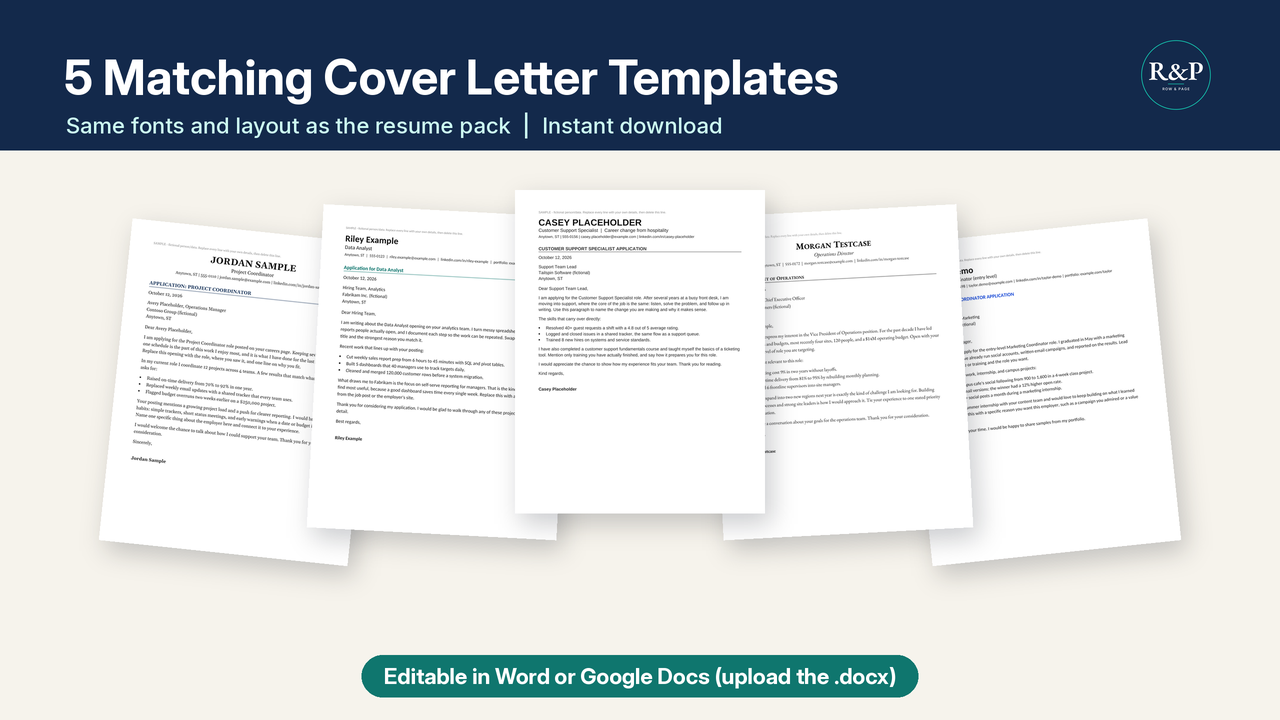
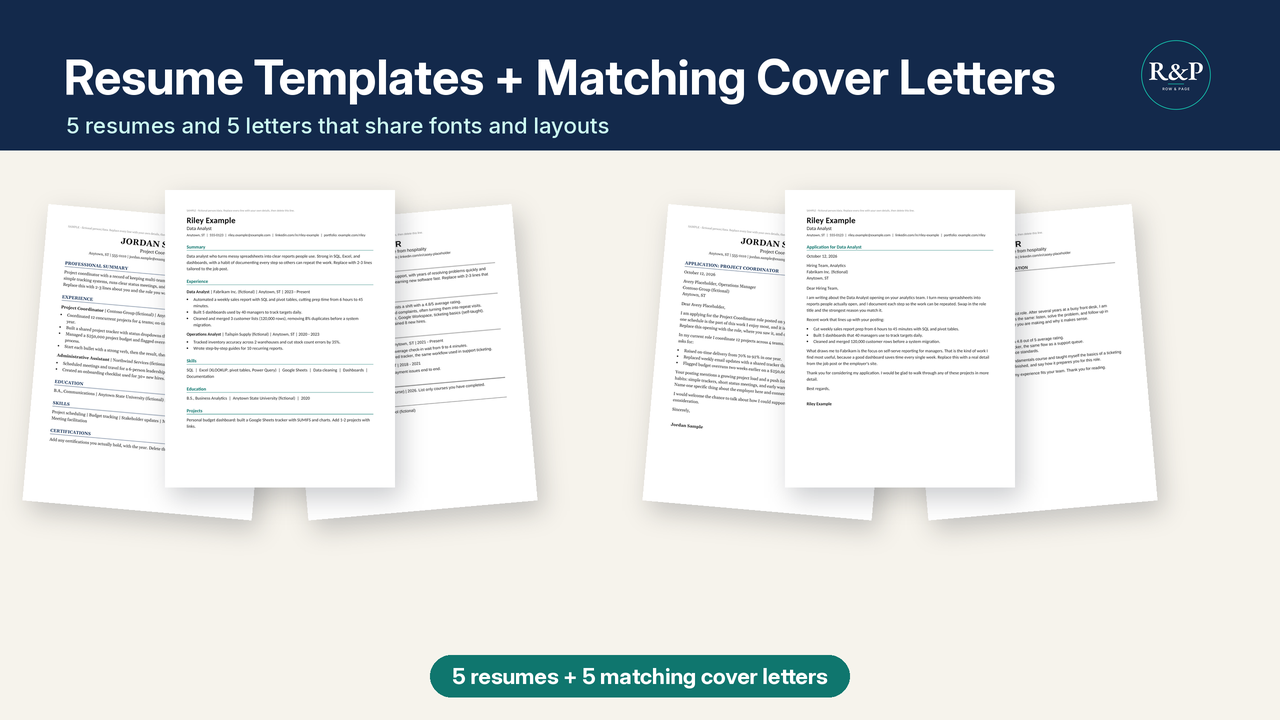
Fill one first sentence from the list above, then write two or three proof bullets from work you really did. For a one-page layout of the same four parts, use the Matching Cover Letter Pack (5 templates plus a guide). A template cannot guarantee an interview.