Row & Page / Guides
Career Change Cover Letter Template (Fill It In Here)
I wrote this Skills-First cover letter at Row & Page for a career change you can fill in the same day. It is plain and single-column, for Word or Google Docs. A template cannot guarantee interviews. It gives you four parts and a place to put facts you can explain out loud.
Fill-in-the-blank generator: your career change opening
Type your own details. The text below builds the first part of the Skills-First letter as you type, and stays on your device.
Only list skills and training that are true for you. A template can't guarantee interviews.
The four parts
- Paragraph one names the role and the change you are making, and why it makes sense. One sentence on the shared work is enough.
- Next comes the line The skills that carry over directly: and three short proof bullets.
- Next, one paragraph on training you have actually finished, and how that training prepares you for a task in the posting.
- End with a short close. Ask to explain the fit, then thank the reader.
Copyable template
Paste this into a blank document. Replace each bracket and delete the brackets. If no name is given, write Dear Hiring team.
Dear [Hiring manager name or Hiring team],

I am applying for the [Job title] role. After [how long] in [your current or recent field], I am moving into [new field], where the core of the job is the same: [shared work in one sentence].

The skills that carry over directly:
- [Verb] [what you did] [result you can point to].
- [Verb] [what you did] [result you can point to].
- [Verb] [what you did] [result you can point to].

I have also completed [course, certificate, or self-study you finished]. That work prepared me to [task from the posting you can now do].

I would appreciate the chance to show how my experience fits your team. Thank you for reading.

[Your name]
[Phone]
[Email]
Each bullet uses verb + what you did + result. A result can be a count, a rating, a tool, or someone you trained.
Fictional sample: Casey Placeholder
This sample is fictional. Casey Placeholder is not a real person, and the front desk is not a real workplace.
Paragraph one:
"I am applying for the Customer Support Specialist role. After several years at a busy front desk, I am moving into support, where the core of the job is the same: listen, solve the problem, and follow up in writing."
The skills that carry over directly:
- "Resolved 40+ guest requests a shift with a 4.8 out of 5 average rating."
- "Logged and closed issues in a shared tracker, the same flow as a support queue."
- "Trained 8 new hires on systems and service standards."
Training:
"I have also completed a customer support fundamentals course and taught myself the basics of a ticketing tool."
Close:
"I would appreciate the chance to show how my experience fits your team. Thank you for reading."
Use the shape. Skip any training you have not finished.
How to find your carry-over skills
- List the posting's repeated tasks. Mark what appears more than once and what is named at the top. Keep four to six tasks.
- Match each kept task to something you actually did. If you cannot point to a real shift, project, or person, drop it. Stop at three.
- Write each match as
verb + what you did + result. Drop the old job title so the line stands alone.
Made-up worked example. Riley Example works nights at a regional logistics company and wants an operations coordinator role.
- Update a tracker: "Logged damaged cartons in a shared sheet before the morning shift, so the day crew did not recount the same pallets."
- Write a handoff: "Wrote a half-page handoff when a trailer arrived short, naming the missing count and who to call."
- Train a backup: "Trained two new hires on scanner steps until each person finished a full bay without a prompt."
A weak opening, rewritten
Fictional weak opening:
"I know I do not have direct experience, but I am a hard worker and I am eager to learn your industry."
Same fiction, Riley Example, in the template pattern:
"I am applying for the Operations Coordinator role. After three years on the night sort at a regional logistics company, I am moving into office operations, where the core of the job is the same: keep a shared record accurate, hand the next person a clear note, and teach the steps."
Mistakes to leave out
- Apologizing for the change. Cut lines like "I know this is a stretch." State the move, then give proof.
- Listing every old duty. Keep three bullets that match the posting. A duty with no match stays off.
- Claiming training you have not finished. "I have completed" means done. If you are midway, say midway, or cut the line.
FAQ
Should I mention the career change in the first paragraph?
Yes. This template puts the role and the change in paragraph one, with one sentence on why the work is the same. I do not save the change for a later paragraph.
How long should it be?
I keep four parts: opening, three bullets, training, and a two-sentence close, on one page. If it runs long, cut back to three bullets.
What if I have no relevant training?
Leave the training paragraph out. The template still has paragraph one, three bullets, and the close. If you did real self-study, name the tool or exercise you finished. Do not borrow a course name to fill the blank.
Next step
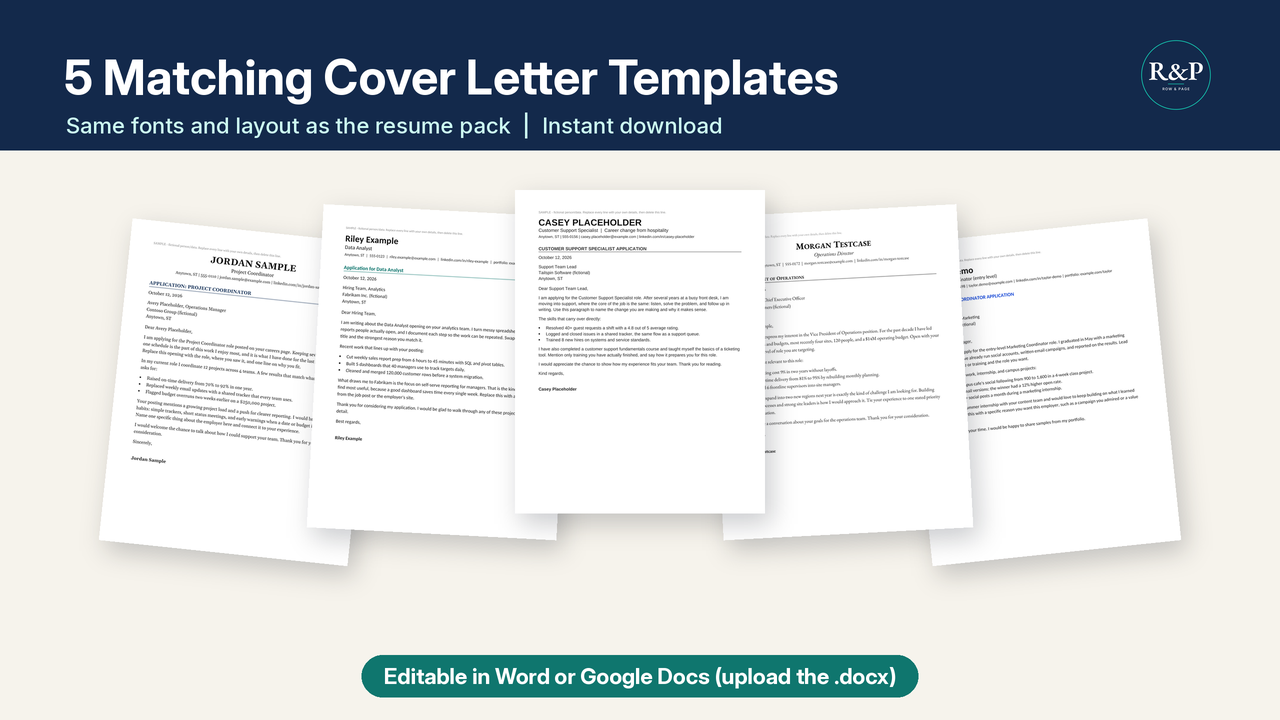
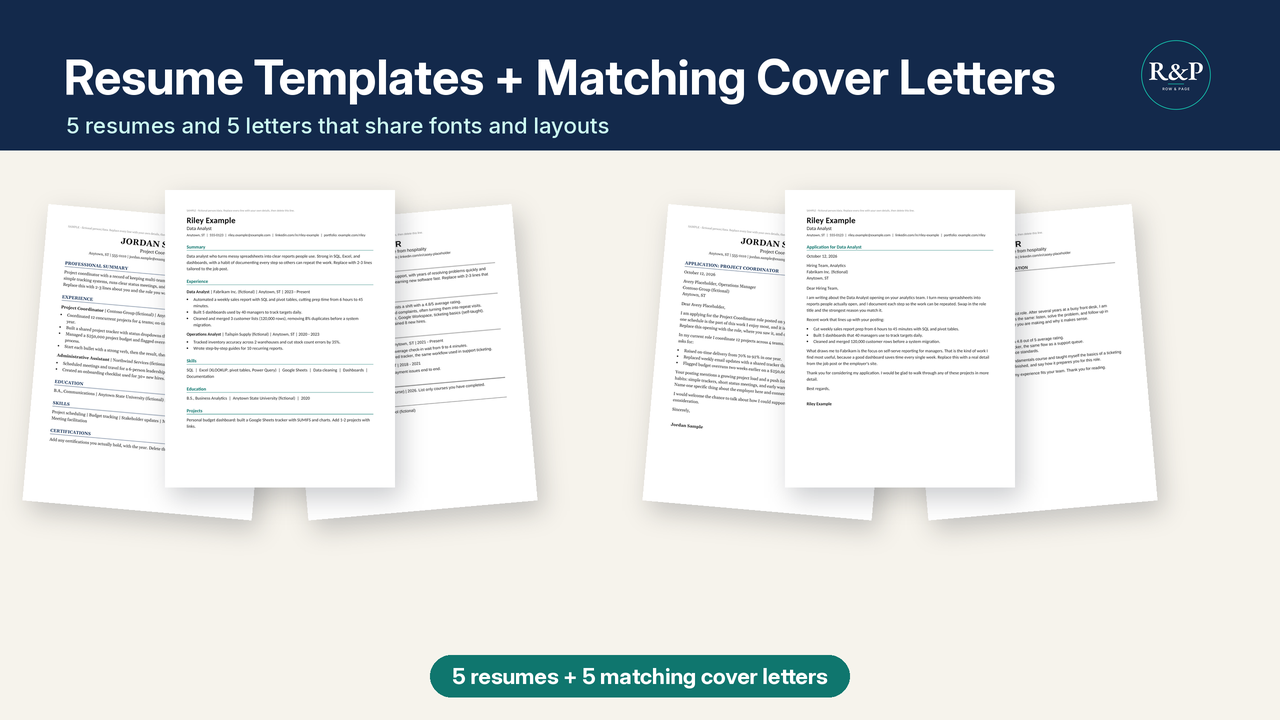
Write your three bullets first. The Matching Cover Letter Pack includes this Skills-First letter among five cover letter templates. The Resume + Cover Letter Bundle adds the matching Skills-First resume. My ATS-friendly resume template for Word guide shows the plain Word layout I use. No template can guarantee interviews.